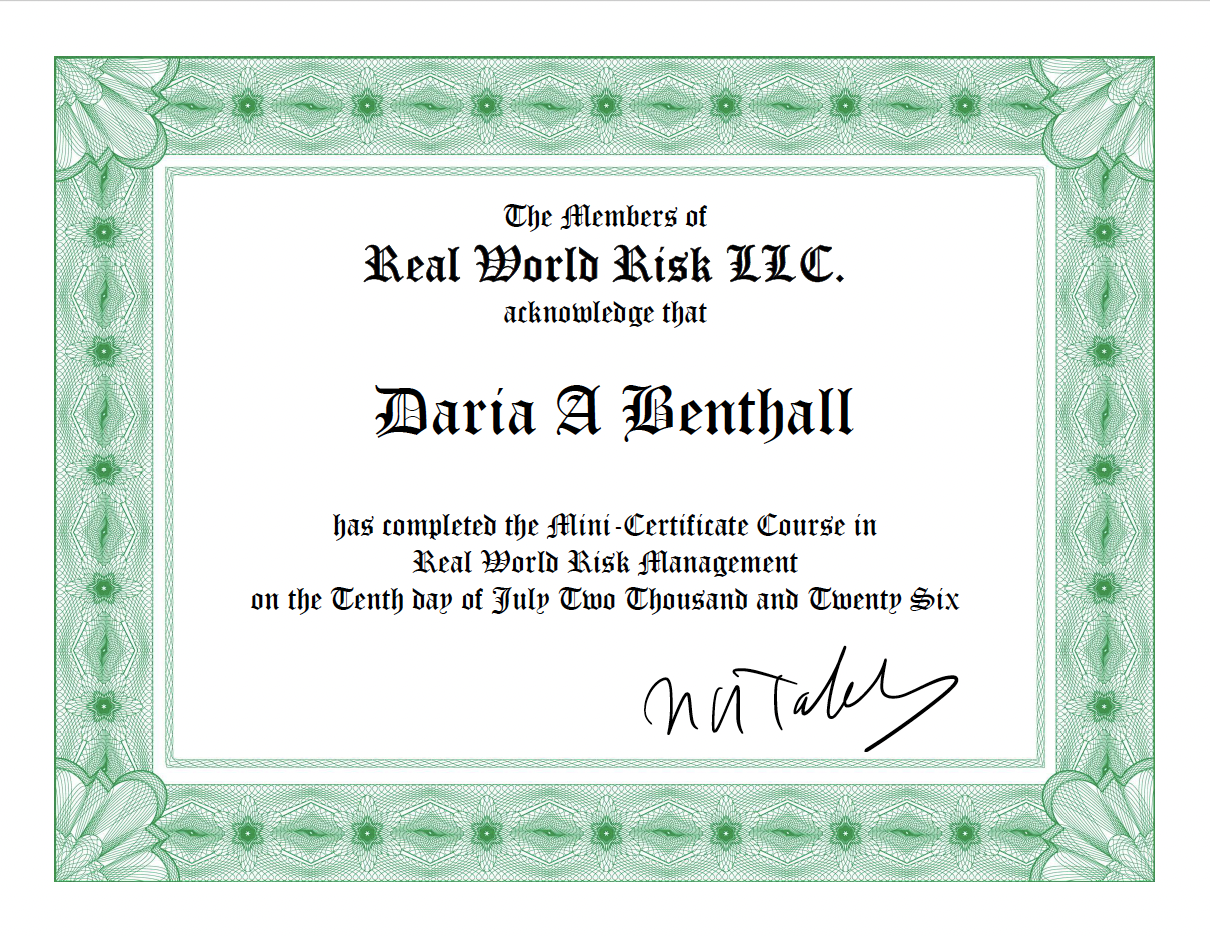
Year after year, I find myself drawn back to structured learning. I used to think it was a flaw. Now I'm accepting that this is just what I am: I can't stop learning, and sometimes reading or watching videos isn't enough, so I take courses and classes instead.
This year was no different. After months of gardening, relearning to sew, and finally getting the house organized, I was wondering what to tackle next when I saw Nassim Taleb's tweet about a new cohort for the Real World Risk certificate. I've loved Nassim's books since I read 'Black Swan' many years ago, and I occasionally reread them, so I applied right away and, luckily, was accepted.
Interestingly, besides learning about risk-taking in various domains (finance, reinsurance, health, climate, and more), the greatest lesson for me was more spiritual.
First, it reminded me that I used to love math, and maybe it's time to revisit this passion.
Second, I genuinely learned not to be ashamed of asking "stupid" questions, or rather, to ask them despite the shame.
Third, it was so refreshing to see great minds like Nassim Taleb, Robert Frey, and Raphael Douady having a genuine question and answer exchange with Stephen Wolfram, and being so humble and real about it.
Fourth, it was amazing to see people's sober takes on challenges like risk modeling in climate change, a topic that, in my view, has become too ideological to allow for honest intellectual debate. And yet there it was: a realistic, somewhat critical take from someone actually doing this work, explaining why it's still worth doing despite its current shortcomings.
It was also refreshing to see Robert Frey, a mathematician, address the dangers of being overly obsessed with science and logic, of being a hyper rationalizer where everything needs numbers or theory behind it to be worth discussing, and to hear him say that maybe what we think is random isn't random; we just don't know the reason yet. It resolved a contradiction I'd struggled with for a while. I used to think it was either common sense and intuitive ideas, or statistics, never both. Now I see they can coexist.
Perhaps my favorite part was complexity. I'd peeked into it before, but it always felt too abstract and theoretical, and I'm a practitioner by spirit. Now I have real ideas about what to look into and how to apply complexity to my existing projects.
If anyone is interested in real world risk and how it works in life, not just on paper, I can't recommend this course enough. I now see why so many people return year after year. It's simply a great place for intelligent people from various fields to come together and have productive, honest discussions about risk, complexity, and life itself: https://www.realworldrisk.com